-
|
Mentoring in Higher Education: Best Practices
|
| |
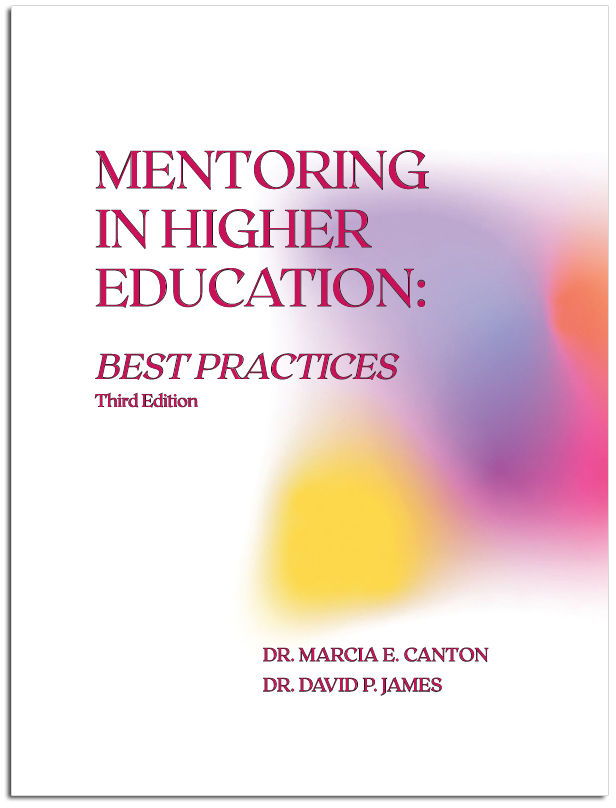
Mentoring in Higher Education:
Best Practices
Third Edition, Textbook
by: Dr. Marcia E. Canton & Dr. David P. James
Mentoring Enables Those
Who Can Make A Positive Difference
Mentoring in Higher Education: Best Practices focuses on models of effective mentoring that can be used for staff development and also what administrators and faculty can do to work effectively with diverse student populations in order to promote high levels of student academic success.
This book describes the significance of best mentoring practices in academic institutions and is designed as a resource for boards and presidents, chancellors, faculty, affirmative action officers, administrators of mentoring programs, academic affairs officers, student counselors, and participants in mentoring programs.
The textbook also proposes strategies for improving the effectiveness of existing and new programs in mentoring that were designed to increase retention and graduation rates of all students, with emphasis on “students of color.”
Textbook: 100 pages, 8.25" x 11"
ISBN: 978-1-61170-334-4
|
|
Purchase "Mentoring in Higher Education: Best Practices, 3rd Edition" from any of the links below: |
|
|
|
Mentoring in Higher Education: Best Practices, 3rd. Edition
Part I, The Mentoring Process discusses elements of best mentoring practices in academic institutions, and retention and the significance of mentoring. It also examines what a mentor is, definitions of a mentor and mentoring, the diverse roles of a mentor and mentoring, and principles of effective mentoring.
Part II, Program Development, presents a summary of strategies and steps involved in program planning, screening, selection and training of mentors and protégés, administering the day to day program, types of mentoring relationships and the impact of mentoring on protégés, mentors and institutions of higher education.
Part III, Marketing The Mentoring Program, presents strategies and recommendations for promoting mentoring programs, including elements of mentor and protégé handbooks.
Part IV, Program Evaluation, presents criteria for evaluation, factors related to evaluation of mentoring programs and program evaluation examples.
As we approach the new millennium, it is increasingly clear that our Nation’s future depends on the existence of a strong higher education system that provides learning opportunities at every level and throughout life. As educators, we have an awesome responsibility to prepare students to be full participants in the global society.
Responding to these realities, many organizations are struggling with the challenges that lie ahead for them in reaching out to diverse students. For some, these challenges are completely new; for others, the challenge is to improve current efforts. Planned mentoring programs and strategies have been effective in responding to these challenges, when implemented within a broad, flexible framework and accompanied by a clearly stated program mission, goals, and objectives. In addition, preparing a college campus to promote retention success of students requires the dedication and involvement of the entire campus community. Mentoring is one of the most effective tools that can be used to heighten the level of consciousness in working with diverse students and promoting retention.
This Third Edition of Mentoring in Higher Education: Best Practices focuses on models of effective mentoring that can be used for staff development and what administrators and faculty can do to work effectively with diverse student populations in order to promote high levels of student academic success. |
| |
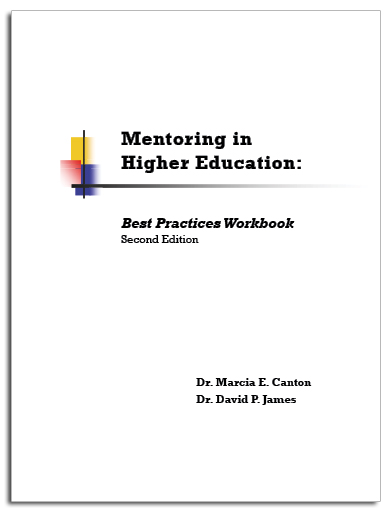
Mentoring in Higher Education:
Best Practices Workbook
Mentoring Assists in Preparing
Our Nation’s Future Generations
Mentors have an awesome responsibility to prepare students to be full participants in the global society. At no other time has there been more discussion, thinking, and tension about issues in higher education than there is now.
The Workbook introduces practical approaches for designing, implementing and evaluating a planned mentor program. The case studies are designed to present real-life challenges and elicit a genuine discussion of tangible solutions. The activities are designed to assist mentors in unlocking students potential and nurture their educational aspirations.
The workbook consists of suggested exercises for all mentoring participants and includes protégé vignettes, faculty vignettes, and basic questions for starting and implementing a mentoring program. Each suggested exercise or question begins with a list of skills or proposed mentoring activities that program administrators, mentors and protégés can use as additional sources of training and professional development activities. In all cases, the exercises and questions are specifically designed to enhance the mentoring process.
Workbook: 62 pages, 8.25" x 11"
ISBN: 978-1-61170-059-6
|
|
Purchase"Mentoring in Higher Education: Best Practices Workbook" from any of the links below: |
|
|
|
| |
|
|
|
Dr. David P. James and Dr. Marcia E. Canton have been committed to the retention
and graduation of students in higher education for over thirty years.
They are available to conduct on-site workshops at your respective institutions.
Contact them for further information.
|
|
Marcia Canton, Ph.D.
|
|
|
Marcia E. Canton, Ph.D. is an educator and consultant, specializing in organization and management development. She is President of Canton Associates, a consulting firm developed to improve the effectiveness of educational institutions and the workplace by assisting decision-makers and managers in a diverse labor force. She is also Professor Emeritus from San Jose State University where she taught a myriad of health, diversity and management courses for more than twenty-five years.
She also served as the first Coordinator of the Faculty Mentor Program which received a Chancellor’s Award for outstanding service.
e-mail Dr. Canton: drcanton@pacbell.net
|
|
Dr. David P. James
|
|

|
Dr. David P. James began his career at Prince George’s Community College in 1971, as assistant director of Community Services. He retired in 2008 as dean of Educational Development and Degree/Extension Centers and Special Programs. He received his bachelor’s degree in social science from Elizabeth City State University, his master’s degree in world history from Georgetown University, and his doctorate in higher education from Nova Southeastern University, Fort Lauderdale, Florida.
He served as President of the International Mentoring Association from 1988 to 2000 and is an internationally known leader and expert on training, establishing, and evaluating mentoring programs. He has made numerous presentations on mentor and protégé training and the essential elements for comprehensive formalized mentoring programs.
e-mail Dr. James: drjames@dpjmentoring.com
|
|
|
|
|
|
|
|