-
|

Hometown of Napa is not what it once was—not even close
By Carl Heintze
For Saratoga News |
Napa, the town where I grew up, is not the town where I grew up anymore.
The current issue of VIA, the magazine of the California Automobile Association, tells me that. But I already knew it. I've been back to the old hometown and it isn't.
When I was growing up, Napa was a sleepy little place of 7,000 where no one had ever heard of wine and hardly any vines grew. The only place you could find a grapevine was beyond St. Helena where Greystone Cellars and a couple of other vintners made medicinal and sacramental wines.
Prohibition was just ended, and vineyards and vintners were still recovering. The snob appeal that has descended on Napa lay far in the future.
Then a single bridge spanned the Napa River in Napa—on Third Street. Now there are two others—larger, more grand and farther downstream.
The old stone bridges over the Big and Little Trancas still stood, as they are today. The river was muddy then, as it is today, but it doesn't smell as it did. In those by-gone days the river was the town sewer. You could smell the sewage in the summertime, especially if the wind was right.
The only industry in town was a pants factory. It lay on the main road into town from Vallejo across from where there once stood the station for the Napa Valley Railroad. For a while the railroad ran through town on Third and Jefferson streets, but later its tracks were moved to their present place where they carry the Wine Train up the valley.
The route was electric and carried passengers down the valley to Vallejo where they could get a ferry to San Francisco.
The Vallejo-San Francisco ferry of today is grander but less frequent than was the old one, but a voyage on it can give you an approximation of what going down the Bay was like when the Golden Gate and Bay Bridges were being built. It was a great trip and it ended in a great place, the Ferry Building, at the foot of Market Street where it was possible to get a streetcar to almost anywhere in San Francisco.
Streetcar tracks ran four abreast up Market.
Nowadays BART does the same thing, but it's mostly underground.
The Napa Courthouse in Courthouse Square was all there was to county government. Its single building included the county jail, the single superior court and the county library. That's not so today. County government covers a couple of blocks.
And a lot of the trees around the old courthouse are gone. I suppose they got too big and had to be cut down.
The hills on either side of town were mostly green grass, madrones and oaks. Some of the trees are still there, but a lot of what used to be grass has been covered over with houses. Houses lie on the ridges, in hollows and on little hilltops off the main valley.
Once upon a time I was going to build a house on such a site on the west side of the valley. Now I never will. Someone beat me to it.
Some things are still the same, though. The high school I attended is still there and looks about the same. But the junior high—we called it intermediate—is long gone and its playground covered over with stores and housing.
So is the house in which I grew up. It was moved to make way for stores, and I've never been sure where it went. Most of the old white houses on First Street, built by New Englanders moving west to California, also have disappeared.
A few still remain on other streets and the Presbyterian Church on Third Street, the single highest building in town, still sticks its spire into the California air, a unique kind of welcome as you drive into Napa.
The plots in Tulocay Cemetery on the town's east side are getting full, however. A lot of my relatives sleep there, gazing down on the place they built in what once were dry, golden fields of grass I don't go there very often, though I suppose one day I will have to go and stay.
Spending all your boyhood and teenage years in a single town gives one a special attachment, somehow, a little like a chain. It's always pulling you back in search of the days when you were young and when the world was filled with hope and promise.
These days the promise is not so much what is as what was, the heritage of a wonderful place to live and to grow. The Napa of today is upscale, even snooty, the realm of the wine buff and the restaurant gourmet, the gift shopper and the tourist from anywhere.
As Thomas Wolfe once said, "You can't go home again."
But you can have memories.
Carl Heintze can be reached at carlheintze@juno.com.
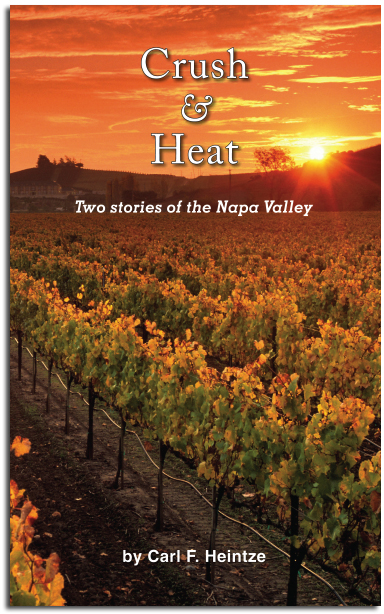
Carl authored two novellas about the Napa Valley in: Crush & Heat
Back to top
|
A trip to Kauai is like going to the movies, or at least on location
By Carl Heintze,
For Saratoga News |
Every noon a small bus stops at the picnic ground behind Anini Beach on the island of Kauai just in time for lunch.
The bus is one of several trekking around the island these days on tours of movie location sites. The tours are interesting and an easy way to see Kauai, the northernmost of the Hawaiian chain.
Of course, you can do the same thing on your own in a rental car. Kauai has only a single highway that does not quite circle the roughly round island.
If you do that, though, you have to know where to look for the familiar scenes. The bus guides already know where they are, of course, and do it in less than a day.
For Kauai has been home to a remarkable number of films seemingly unrelated to Hawaii: Jurassic Park, Six Days, Seven Nights and less recently, South Pacific. Currently, there is yet another under way, the umpteenth version of Pirates of the Caribbean, which is on location near the remote Napali cliffs side of Kauai.
Napali is not the easiest place to get to. Transportation is impossible by car. Napali has no roads, though it does have a very rough trail partway to it. It is available mostly by boat. Boats from Hanalei Bay or Port Allen on opposite sides of the island bounce their way north or south, transporting food, actors, directors and crew for the filming.
Just what this has to do with the plot of Pirates, set on the opposite side of America, probably doesn't matter. The locale is supposed to be in the tropics, and there is plenty of that on Kauai. Above Napali is the Alikai Swamp, in the throat the extinct volcano that created Kauai eons ago, reputed to be the wettest place on Earth. It is, to say the least, damp and lush and so are its various sides. It will do as a tropical Caribbean isle anytime.
Other scenes from other movies, some on the tour and some off, are at other widely separated places on the island. One of the scenes in Six Nights, Seven Days (or is it the other way around?) is a shot of the endangered couple, Anne Heche and Harrison Ford, jumping off a cliff into the ocean.
The cliff and the ocean are on the south side of the island, not far from the Kauai Grand Hyatt and Shipwreck Beach. In the movie they are on a deserted island—well, deserted that is except for bad guys. No Grand Hyatts, no beaches of any consequence.
Just how Kauai got to be so popular as a movie location is not certain. South Pacific was shot long ago, not far from Hanalei Bay on Lumahai Beach, a lovely yellow sand beach, even though it is not thought of as a good place for swimming. It appears to have been one of the first movies to use a Kauai location site.
Thereafter Steven Spielberg seems to have been attracted to it. Many of the movies are films he has produced or directed or both. Spielberg seems have a unit working almost every year.
That was not true earlier. There was a lapse between the filming of South Pacific and more recent movies.
When it was filmed, movies were more difficult to shoot on location than they are now, though probably less expensive.
Equipment was heavier and transportation wasn't as routine. Kauai is easy to get to these days. There is a direct flight from Los Angeles to Lihue, the principal city on Kauai. And there now are a lot more good hotels and condos in which to stay while the shooting is on.
What's more, Kauai welcomes the Hollywood invasion. It is a boon to the economy. In the last few years sugar, the island's other principal industry, has dried up. The cane fields are now filled with weeds. Tourism is about all that's left. Whether it is film crews or tourists, they are all grist for the Kauai mills now that sugar is no longer refined there. So the tours go on daily every week, a lot of them picking up passengers from the weekly visit of an around-the-islands cruise line that docks at Nahwiliwili, Kauai's principal port. The ship arrives and departs in a single 24 hours and the movie tour takes most of that day to accomplish.
In some ways that's unfortunate because there a lot of other things to see on Kauai: the Kaulaulau Valley, the cliffs at Napali (again only reachable by small boat) and many sandy and pleasant beaches where swimming, surfing and scuba diving and snorkeling are possible.
And of course there is just plain sitting in the sun. The movie location people don't get to do much of that, but then they're getting paid, not paying to visit.
Carl Heintze can be reached at carlheintze@juno.com.
More stories about Kauai are shared in Carl's book: An Island in the Turquoise Sea

Back to top
|

Memories of the Great Depression not all that great
by Carl F. Heintze
For Saratoga News
|
When the Depression came, I was a boy of 7 or 8. (It depends on when you date the beginning of the Depression, or the Great Depression, as some used to call it.) So I don't remember much about it.
I do, however, remember when the banks all closed, because my mother thought it was more or less the end of the world. The banks had never all closed that way, all at once, and besides she had worked as a secretary at the local bank and she simply could not accept that you couldn't get money out of its coffers.
Banks were like the stock market of today. They just kept on dispensing money as if it had no end, as if there was no bottom to the pot.
But the bottom was gone. It suddenly had disappeared and with it, a lot of illusions about our world.
Certainly the bottom of her world had disappeared. I don't believe she had much money in or out of the bank, but it was the sudden lack of security that made it so difficult for her.
I also remember once going to Sacramento with her to see my grandparents and seeing hundreds of homeless, jobless men circling the blocks along the Sacramento waterfront, waiting to get into a soup kitchen to get something to eat. I'd never seen that before (and never saw it again because I didn't live in Sacramento). But it stuck in my mind. They looked so dark, so sad, so without hope.
Fortunately, I lived in a small agricultural town north of San Francisco. The Depression had an impact on it, but not much.
No one went hungry. Everyone could grow food to eat and they did. Times were tough, but they weren't that tough. Or so it seemed to me, anyway.
I did have one uncle, however, who had his ranch foreclosed on and had to move to a smaller place, though he still seemed at least partly solvent, just not the owner of as much land as he once had held.
I think of all these things because the rumblings and groanings coming from New York City and Washington seem to portend another time of economic agony. It's as if we have come full circle and we're facing the same kind of crisis all over again.
Of course, not a whole lot of people remember the Depression, although most of them have surely heard of it.
With those that do recall, I remember the days that followed 1929 — although 1932 seems a more likely date for its beginning to me. The`30s were a time of trial for the United States — for the world, for that matter. Communism and fascism were on the rise in part because of the fears the economic disaster had awakened everywhere.
Although President Roosevelt told us, "We have nothing to fear but fear itself," fear was there for all to share. It permeated most everything. The nation seemed paralyzed and it was years before it seemed to have gotten itself together.
In many ways the coming of World War II awakened our spirits again because it gave us a tangible foe to face. The enemy during the Depression had been anonymous, surreptitious. Perhaps that's why we equated it later with Communism, even as Communism adopted the trappings of a secret society (phony names like Josef Stalin, cells with secret memberships, party cards and the like).
The Depression also, it seems to me, marked a sudden change of course for our country. While it is true this probably happened more rapidly than it might have because of World War II, the changes in our economy brought on by the Depression were fundamental. They are with us still.
It's possible, even probable, that we are due for more changes in our economics because of what, for lack of a better term, we can call the mortgage crisis. The over-extension of credit, which seems at the bottom of the present mess, has to be resolved some way. How we do that will have a lot to do not only with how we get out of our quandary, but also on how we do business in the future.
Already legislators are talking about trying to prevent the gargantuan salaries paid to some corporation leaders and about putting tighter reins on how money is lent. I'm not enough an economist to know whether things like this are going to make a difference. All I am observing is that change is in the air and change often is difficult to experience.
But at the same time I also have to note that, as Lincoln or someone said, the one sure thing we are to experience in life is change.
Neither the nation nor we are static. We change. It changes. And what we know today will not be what we are to know tomorrow.
And what tomorrow will be like is as uncertain as what today has become.
Carle Heintze can be reached at carlheintze@juno.com
Back to top |
|
| |

Thinking about the infantrymen ... every day
By Carl Heintze
There's an Internet site devoted solely to infantrymen.
I don't suppose I should be surprised at that. There are websites devoted to almost anything. In the old days of the Internet, they used to be called newsgroups. They are places where people with like interests can exchange information, ideas and messages. They run the gamut of almost every human endeavor.
And there's no reason why infantrymen shouldn't have one.
Because infantry combat is one of the most intense experiences one can experience--life threatening most of the time--most old infantrymen, including myself, tend to remember every detail of that time, now fortunately long ago.
And there's something about being an infantryman that makes it unique, that creates a kind of fraternity. First, you carry anything you're going to need in the performance of your duties with you, most of it on your back or around your waist.
Secondly, although you're an individual and you can walk and talk like a human being, you can't really move about freely. You're really at the mercy of others--your squad, platoon or company leader. They tell you where to stand, march, lie down, run or stand still.
You don't get to argue about this. Infantry combat is the business of moving groups of men around, or, as the Dictionary of Occupational Titles (published by the army) puts it, being in the infantry means "to close with the enemy, kill or capture him and occupy his ground." (I suppose I amend this to say "his or her ground," as women are getting closer and closer to ground combat.)
Most of the business of the infantry and infantrymen is just that--moving from one place to another to stand or lie on a certain strategic section of the earth.
There often doesn't seem any apparent reason for where you're sent, how long you are there or the fact that you're not doing anything while you are there. Presumably someone higher up the chain of command has a reason for you doing what you're doing--although you can't always count on that.
In the fog of war often nothing makes sense--not to you, not to the enemy, not to anyone.
All these things make being an infantryman tough. You're out in all weather; you are constantly afraid of getting wounded at the least and killed at the most; you don't have a clue as to what you're doing; and you can't do much on your own to better your lot.
I was thinking of all these things because of the members of the 10th Mountain Division and the 101st Airborne who have been trudging around the Afghan mountains in the snow at 8,000 to 10,000 feet looking for various Taliban and Al Queda infantrymen who are trying to kill them (and vice versa).
The weather is miserable, the troops are carrying large packs and moving slowly because of the altitude, and they are meeting more resistance than they anticipated.
I know how they feel. I spent most of the winter of 1944-'45 trudging through the snow along the Belgian-German border while the enemy fired artillery and mortar shells at me and my fellows and occasionally shot their machine pistols and rifles in our direction.
We slept out in all weather, were wet, cold, frightened and pretty much unaware of why we were where we were. Most of us were replacements. We had been shipped overseas as unattached individuals, destined to be inserted into the ranks of companies decimated by the fall fighting at the end of the war.
Most of us were ill trained. Some of us were physically handicapped. (I remember one deaf soldier who somehow had made it to the front in spite of being unable to hear incoming shells, and a second who arrived without a trigger finger.)
Most of us had gotten into the Army to do something else and had been transferred into the infantry when casualties were far larger than the campaign's commanders had anticipated.
Still, we learned. If we didn't, we were wounded or killed. And we weren't unique. The enemy side had rounded up the same set of misfits--men and boys with bad stomachs, the old and the young who were sent into the final battles of the war because there wasn't anybody else to send.
I'm sure that's not the case in Afghanistan. The American infantry there are all volunteers. They've spent months training, and they are magnificently equipped and supported. They know why they are where they are and what they're supposed to do.
But it's still the infantry; and it is still infantry combat--single men moving about in the cold and the high altitude, being shot at and shooting back, trying to dislodge the enemy from the high ground, still dealing with fear and trembling.
As an old infantryman, my heart goes out to them. As an old infantryman, I know how they feel. I don't wish to take anyone's place. One war in one lifetime is enough.
And I hope others do, too. |
|

Robertson Publishing
59 N. Santa Cruz Ave. Ste B., Los Gatos, CA 95030 USA
408-354-5957 or Toll Free 888-354-5957 |
|
|